
ShinyHunters Ransomware Group: Dark Web Data Leaks Case Study
- securedmonk
- Jun 22
- 15 min read
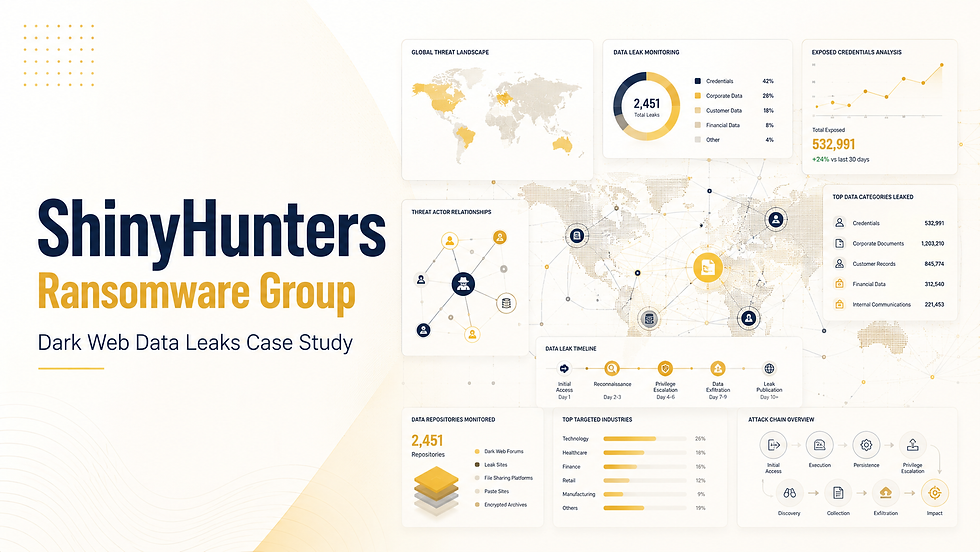
Analyzing the Evolution of One of the Most Active Data Extortion Threat Groups on the Dark Web
Introduction
The paradigm of cybercrime monetization has undergone a fundamental structural shift over the past several years, driven by the decline of traditional, file-locking ransomware execution and the rise of highly targeted, non-encrypting data extortion. Historically, threat actors prioritized the deployment of symmetric and asymmetric encryption algorithms to lock local systems, forcing victims to purchase decryption keys. However, as enterprise backup architectures, disaster recovery operations, and endpoint detection and response (EDR) platforms matured, the financial leverage of system encryption deteriorated. According to academic analyses of the extortion lifecycle, organizations increasingly choose to rebuild systems from secure backups rather than pay high ransoms, which has forced cybercriminal syndicates to pivot toward data-centric coercion. By shifting focus to massive exfiltration campaigns, modern threat actors bypass the technical hurdles of endpoint execution entirely, targeting the integrity and confidentiality of proprietary datasets, employee credentials, and customer personal identifiable information (PII) to enforce payment.
Within this landscape of modern ransomware operations, the ShinyHunters Ransomware Group stands out as one of the most sophisticated and aggressive entities targeting enterprise networks. Emerging initially as a prolific database broker in underground forums, the group has transitioned into a highly structured, non-encrypting Data Extortion Groups operation. Rather than developing or deploying custom file-encrypting payloads, this collective focuses heavily on Cloud Data Theft, targeting single sign-on (SSO) architectures, SaaS environments, and critical cloud databases. By exploiting trusted third-party integrations and abusing delegated authentication mechanisms, they exfiltrate massive datasets and publish them on their dedicated Ransomware Leak Portal to apply extreme pressure on victims. Understanding the tactical maneuvers, operational infrastructure, and negotiation frameworks of this group is critical for security teams tasked with defending modern cloud deployments.
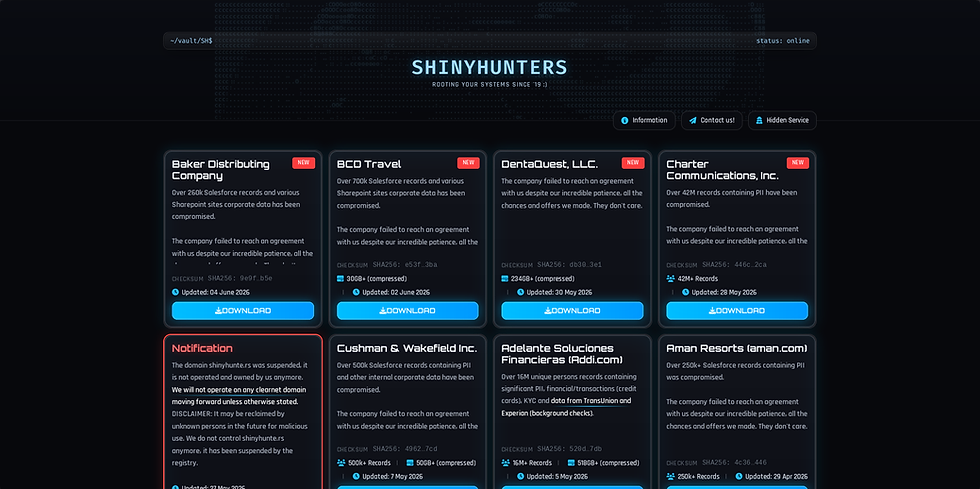
Organizations listed on the ShinyHunters leak portal after failed negotiations.
Who Are ShinyHunters Ransomware Group?
The ShinyHunters Threat Actor collective first appeared in January 2020, immediately establishing a reputation for high-volume data compromise. Unlike many contemporary ransomware-as-a-service (RaaS) operations that rely on affiliate networks to deploy locker binaries, ShinyHunters emerged as a dedicated database broker on the now-defunct RaidForums and subsequently on the ShinyHunters Data Leak Forum (BreachForums). Their early campaigns targeted massive consumer-facing platforms, beginning with the breach of the mathematical education application Mathway (25 million records) and the Indonesian e-commerce platform Tokopedia (91 million records). The group specialized in extracting full database backups, cracking password hashes, and selling clean SQL dumps to the highest bidder in underground marketplaces.
Geographically, the group operates as a decentralized, internationally distributed collective. Although several key affiliates have been apprehended including French national Sébastien Raoult, who was arrested in Morocco in 2022 and extradited to the United States after pleading guilty, and four additional individuals arrested in France in June 2025 the group's core leadership remains highly active under the alias shinycorp. CTI researchers widely assess that the group is a core component of "The Com," a fluid ecosystem of young, English-speaking cybercriminals. This association has led to deep tactical collaborations, most notably with Scattered Spider (tracked as UNC3944) and LAPSUS$, resulting in a joint operational front referred to as the Scattered LAPSUS$ Hunters (SLH) coalition. This convergence allows for a clear division of labor: Scattered Spider operators specialize in initial access via voice phishing, while ShinyHunters orchestrates the subsequent SaaS Data Breach exfiltration and ShinyHunters Dark Web portal publishing.
Threat Actor Attribute | Operational Profile Details |
Threat Group Type | Financially motivated data-theft and non-encrypting extortion collective |
Primary Motivation | Financial gain via database monetization, direct extortion, and database resale |
Core Activity | Bulk exfiltration, API token abuse, supply-chain exploitation, and credential harvesting |
Victim Sectors | Financial technology, enterprise SaaS, retail, telecommunications, and higher education |
Leak Site Infrastructure | Multi-tiered Tor-hosted data leak sites and decentralized clearnet mirrors |
Monetization Model | Double extortion, direct ransom demands, and dark web database auctions |
Tracking Designations | UNC6040, UNC6240, UNC6395, UNC6661, UNC6671, Sp1d3rhunters |
Timeline of ShinyHunters Activities
The historical trajectory of the group's campaigns demonstrates a steady progression in targeting capability, scaling from individual database compromises to sweeping supply-chain campaigns that compromise hundreds of enterprises simultaneously.
January – May 2020: The group emerged publicly, executing rapid database compromises against Mathway, Tokopedia, and Wishbone, exposing over 150 million user profiles on underground forums.
July 2020 – December 2021: Scaled targeting to include major consumer networks, leaking Wattpad (270 million records), Bonobos (7 million records), and Pluto TV databases. During this phase, they began advertising a 70 million record AT&T subscriber database, which AT&T formally acknowledged in 2024.
Mid-2024: Executed a highly coordinated campaign targeting Snowflake cloud databases. By using credentials harvested by infostealer malware, the group accessed over 160 customer environments, exfiltrating Ticketmaster (560 million records), Santander Bank (30 million records), and AT&T (109 million call records, resulting in a reported $370,000 ransom payment).
August 2025: Executed the Drift/Salesloft Salesforce campaign. By using TruffleHog to scan public repositories for orphaned secrets, they located valid OAuth tokens for Drift’s integration, compromising approximately 760 downstream Salesforce customer organizations and exfiltrating 1.5 billion records.
November 2025: Conducted a follow-up campaign targeting Gainsight's Salesforce integration, stealing OAuth tokens to compromise over 285 Salesforce instances belonging to Atlassian, DocuSign, GitLab, and SonicWall.
January 2026: Initiated an Okta SSO and enterprise vishing campaign (tracked as UNC6661/UNC6671), using victim-branded credential harvesting portals to bypass MFA and exfiltrate data from SharePoint, OneDrive, and Slack.
April – May 2026: Compromised Anodot’s integration framework, stealing authentication tokens to access the Snowflake and Google BigQuery databases of 13 corporate clients, including Rockstar Games and Canvas.
May 2026: Targeted Instructure's cloud-hosted Canvas environment, exfiltrating 3.65 Terabytes of data containing 275 million records. To enforce a May 12 payment deadline, the group defaced login portals at hundreds of schools before reaching a private resolution.
May – June 2026: Exploited critical zero-day CVE-2026-35273 (CVSS 9.8) in Oracle PeopleSoft Environment Management Hub (PSEMHUB), compromising over 100 higher education and enterprise instances.
Evolution from Data Breach Actor to Extortion Group
The operational history of ShinyHunters reveals a highly structured evolution in their monetization model and technical focus. This transition from database theft to pure, non-encrypting data extortion can be divided into three distinct phases.
Phase 1: Database Theft and Underground Brokerage (2020–2023)
In its infancy, the group operated as a traditional database broker. Their access methodology relied on scanning the public internet for exposed databases, unsecured ElasticSearch or MongoDB instances, and hardcoded API keys left in developers' public repositories. Monetization was volume-based: stolen database dumps were packaged and listed on underground markets, with copies sold to third-party threat actors for secondary operations. Direct contact with the victim was rare, and extortion was not the primary vector.
Phase 2: Corporate Cloud Breaches (2024)
By mid-2024, the group recognized that targeting individual databases was far less lucrative than targeting the unified cloud storage frameworks hosting those databases. They executed highly targeted campaigns against major enterprise data hubs, such as cloud data platform configurations. By using credentials harvested by infostealer malware, the group bypassed security controls and directly accessed the cloud instances of over 160 multi-national corporations. Using specialized exfiltration scripts, they bypassed traditional data loss prevention mechanisms, signaling their entry into active, direct extortion.
Phase 3: Identity Hijacking and SaaS Supply-Chain Extortion (2025–2026)
The group's modern strategy centers on bypassing security perimeters by targeting the identity layer. Using advanced voice phishing (vishing) campaigns and exploiting trusted third-party OAuth integrations, ShinyHunters successfully bypassed multi-factor authentication (MFA) at some of the world’s largest SaaS platforms. This represents a transition from structural intrusion to trusted credential abuse. They do not "break" into systems, they log in using authentic, highly privileged session tokens.
While the group introduced a proprietary Ransomware-as-a-Service (RaaS) variant known as ShinySp1d3r in late 2025 which targets VMware ESXi hypervisors using a Go-based ChaCha20 encryptor their primary operational focus remains non-encrypting data extortion. Enterprise filesystems are left fully functional, avoiding the immediate endpoint security alerts triggered by mass encryption events. Instead, the threat of leaking massive, regulatory-sensitive datasets acts as their primary financial leverage.
ShinyHunters Dark Web Leak Portal Analysis
The core of the group's public coercion campaign is the ShinyHunters Leak Site, a highly structured platform hosted on the Tor network. The site's structural layout and presentation are designed to maximize psychological pressure on target organizations.
The portal uses a minimalist, dark blue aesthetic that displays active listings in a clean card-based format. Visual triage of the leak site home page reveals several major corporate victims, each displaying specific details regarding the compromised dataset and the status of negotiations :
Baker Distributing Company: This card displays that over 250,000 Salesforce records and corporate SharePoint files were exfiltrated. It states that the company "failed to reach an agreement with us despite our incredible patience".
BCD Travel: This card details the exfiltration of over 700,000 Salesforce records and SharePoint data, totaling over 30 Gigabytes of compressed files. It includes a SHA256 verification hash (a53f...3ba) and is marked with a "NEW" tag.
DentaQuest, LLC: Displays a 234 Gigabyte compressed archive with a SHA256 checksum (db39...3e1), noting that the company failed to reach an agreement.
Charter Communications, Inc.: Highlights the theft of over 42 million records containing customer PII, listing the download size and checksum (446c...2ca).
Cushman & Wakefield Inc.: Details the compromise of over 500,000 Salesforce records, showing a 50 Gigabyte compressed archive.
Adelante Soluciones Financieras (Addi.com): Details the exfiltration of over 16 million unique user records containing financial transactions, credit cards, KYC data, and TransUnion background checks.
Aman Resorts (aman.com): Lists over 250,000 compromised Salesforce records containing PII, noting failed negotiations.
Additionally, the site displays a red security notification informing visitors that their old clearnet domain shinyhunters.rs was suspended by the registry and is no longer under their control, warning users that the domain may be reclaimed for malicious use. This demonstrates a high level of operational security, ensuring that their brand is not hijacked by competing threat actors or security researchers.
Each listing features a download button linking to decentralized storage mirrors, where proof-of-compromise (PoC) samples are hosted to validate their claims. The ShinyHunters Victim Portal serves as both a public repository for stolen data and an administrative interface where victims can track countdown timers and access secure, real-time communication panels.
Analyst Observation Box-Threat intelligence analysts observe that modern data leak sites function as both marketing platforms and psychological warfare tools. By displaying precise file sizes, SHA256 checksums, and countdown timers, the group establishes technical credibility and forces executives to make high-stakes financial decisions under extreme pressure. The public nature of the listings is designed to bypass internal incident containment strategies, forcing immediate regulatory exposure and reputation damage.
Understanding Their Victim Listing Process
The progression from initial network access to a public listing on the ShinyHunters Leak Site follows a highly coordinated operational sequence designed to maximize financial return.
The process begins immediately after exfiltration is completed. The group contacts the victim privately via Tox or PGP-encrypted email, providing a detailed breakdown of the exfiltrated dataset and a small proof sample. They typically establish a 72-hour negotiation window, demanding a payment in Bitcoin or Monero in exchange for deleting the files and providing secure shredding logs.
If the victim refuses to respond or declines to negotiate, they are formally listed on the leak site, initiating a public countdown timer. During this phase, the group uses multiple escalation tactics to force compliance:
Targeted Customer Contact: CTI reports confirm that the group often contacts customers of the breached organization directly, notifying them that their personal information has been stolen and urging them to pressure the victim organization to settle.
Physical Harassment & Swatting: In high-profile corporate or educational breaches, members of the group have targeted employees, executives, and their families with threatening communications and, in extreme cases, swatting attacks to force them to the negotiating table.
Asset Defacement: In May 2026, when targeting the educational tech firm Instructure, the group escalated their pressure campaign by directly defacing the Canvas login portals of hundreds of customer schools, displaying countdown ransom warnings to students, faculty, and administrators.
Regulatory Weaponization: The group leverages data protection mandates, threatening to submit detailed compliance violation dossiers directly to data protection authorities if the ransom is not paid.
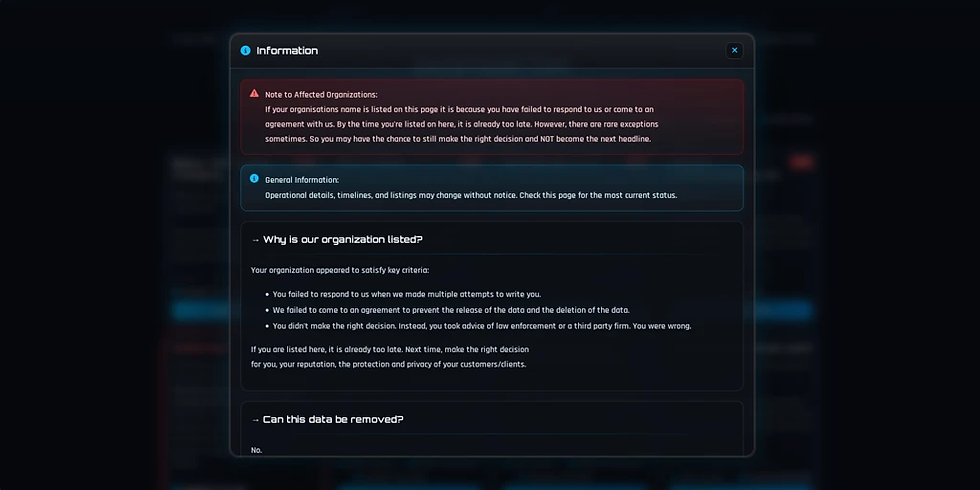
Visual analysis of the site's informational panels reveals their standard response to listed organizations :
Why is our organization listed? The portal states that the victim appeared because they failed to respond to multiple contact attempts, failed to come to an agreement to prevent data release, or chose to follow the advice of law enforcement or a third-party security firm. The panel adds: "You were wrong... Next time, make the right decision for you, your reputation, and the privacy of your customers".
Can this data be removed? The portal displays a definitive "No" once the negotiation window has closed and the listing has transitioned to the public leak phase.
This structured escalation shows why organizations must conduct rigorous forensic validation before accepting threat actor claims as ground truth, as these portals are engineered to project absolute control and induce panic.
Attack Methodology & Initial Access Techniques
The technical execution of a ShinyHunters Cyber Attack represents an automated, multi-tiered campaign that targets the weakest links in modern enterprise security: identity, trusted integrations, and public-facing applications.
Voice Phishing and Credential Harvesting (UNC6661 / UNC6671)
The group relies heavily on sophisticated voice phishing (vishing) campaigns to compromise target identity systems. In these operations, operators impersonate corporate IT help desk or security personnel, contacting employees under the pretext of mandatory security upgrades or password resets.
The victims are guided to highly convincing, custom-branded credential harvesting domains that mirror the organization's authentic Single Sign-On (SSO) portals. These domains are frequently registered using registrar networks like NICENIC and follow specific typosquatting configurations (e.g., <companyname>sso[.]com or <companyname>internal[.]com).
To defeat multi-factor authentication, the attackers utilize real-time Adversary-in-the-Middle (AiTM) phishing kits. When the employee enters their credentials and MFA verification code on the cloned site, the phishing panel intercepts and routes these values to the authentic identity provider. This grants the threat actor an active, authenticated session token, allowing them to register their own device as a trusted MFA factor, securing persistent access.
To prevent detection, the operators often authorize malicious API-based add-ons such as the ToogleBox Recall tool within Google Workspace to silently scan and delete system notification emails, ensuring the victim remains unaware of the new MFA device registration.
SaaS Integration and OAuth Token Hijacking
The group's supply-chain campaigns exploit trusted SaaS-to-SaaS integrations. In these operations, the group scans public repositories for exposed developer credentials and OAuth client secrets. Once a high-privilege integration key is harvested, the attackers abuse the granted API scopes to pivot into connected databases.
This technique was demonstrated during the August 2025 Salesloft/Drift campaign, where the group used stolen OAuth tokens to bypass the host perimeter, allowing them to extract customer contact records from approximately 760 connected Salesforce instances without triggering local network anomaly alerts.
Zero-Day Exploitation (CVE-2026-35273)
When targeting private cloud or on-premises enterprise systems, the group shifts to direct application exploitation. During their May–June 2026 campaign targeting Oracle PeopleSoft environments, the group exploited CVE-2026-35273, a critical zero-day remote code execution vulnerability in the Environment Management component (PSEMHUB).
CTI analysis of their staging infrastructure (142.11.200.186 through .190) revealed highly structured, automated command sequences. Once initial access was established, the threat actors used MeshCentral CLI utilities to map internal networks and extract system configurations :
System Profiling: Initiated basic system checks and verified execution privileges using the commands: hostname; id.
Credential Harvesting: Parsed database credentials from the Process Scheduler configuration file using the command: grep -hE '^[[:space:]]*Address=|^[[:space:]]*HostName=' /u01/app/psoft/ps_config_homes/csprd/appserv/prcs/psappsrv.cfg.
Network Mapping: Audited internal mount points and resolved hosts tables to locate database systems: mount | grep -E "psoft|ps_config|nfs" and cat /etc/hosts.
Lateral Movement: Deployed a specialized fanout script ([victim_abbreviation]_fanout.sh) to automate SSH credential spraying against identified internal hosts using the psoft, oracle, and linuxadm accounts.
Exfiltration: Compressed the stolen directories using the high-performance zstd utility (pv -s "$(du -sb exfil)" | zstd -3 -T0 -o exfil.tar.zst) before transferring the archives to their dark web storage server (176.120.22.24) via outbound SSH connections.
Contact & Negotiation Infrastructure
The group maintains highly secure, resilient, and compartmentalized communications infrastructure to coordinate their extortion campaigns. This setup reflects a high level of operational maturity, utilizing decentralized and encrypted platforms to prevent interception and tracking by security researchers and law enforcement agencies.

The contact page of the leak site showing PGP public blocks and anonymous communication instructions.
The group's secure communications network relies on three primary channels:
Tox Messaging Protocol: The group's primary platform for real-time negotiation. Tox's peer-to-peer, end-to-end encrypted architecture requires no central registration, preventing researchers from locating physical staging points or tracking the messaging sessions.
PGP-Encrypted Email Routing: For asynchronous communications, the group utilizes anonymous, privacy-focused email providers. Commonly used addresses include shinycorp@tutanota.com and shinygroup@onionmail.com. In secondary extortion campaigns, such as the Lamashtu operations, the address LamashtuSupport@onionmail.org was used. All outbound messages are signed with distinct PGP public keys published directly on their leak portal to verify identity.
Decentralized Data Proof Hosting: To provide proof of exfiltration, the group hosts file samples on decentralized networks or secure cloud storage providers, such as Limewire and anonymous cloud servers, avoiding the need to host large file repositories on their primary onion site.
The group's use of standardized communication protocols, verified PGP identities, and automated payment gateways demonstrates a highly mature business structure. This division of roles separating technical access, system administration, negotiation, and public relations mirrors legitimate software organizations, highlighting the industrialized nature of modern cybercrime.
Indicators of Compromise (IOCs) & Warning Signs
Defending against the group's campaigns requires proactive threat hunting and continuous log analysis. The following section details technical indicators associated with their recent campaigns.
Network Indicators
The following table details known active IP addresses and staging endpoints tied to the group's infrastructure, particularly from their 2026 campaigns.
Threat Actor IP Address | ASN | Operational Context |
AS201814 | Staging Host / CVE-2026-35273 Exploitation | |
AS201814 | Staging Host / CVE-2026-35273 Exploitation | |
AS201814 | Staging Host / CVE-2026-35273 Exploitation | |
AS201814 | Staging Host / CVE-2026-35273 Exploitation | |
AS201814 | Staging Host / CVE-2026-35273 Exploitation | |
AS395965 | Attacker-controlled Exploitation Infrastructure | |
AS12479 | Public mirror of the ShinyHunters Data Leak Site | |
AS46375 | Tor Exit Node / Infrastructure Access Point | |
AS46375 | Tor Exit Node / Infrastructure Access Point |
Phishing Domain Lure Patterns
The group registers domain names using registrars like NICENIC, following specific typosquatting patterns designed to target corporate single sign-on portals.
Domain Lure Category | Domain Pattern Structure | Real-World Examples (Defanged) |
Corporate SSO | <companyname>sso[.]com | my<companyname>sso[.]com, my-<companyname>sso[.]com |
Internal Portals | <companyname>internal[.]com | www.<companyname>internal[.]com, my<companyname>internal[.]com |
Support/Helpdesk | <companyname>support[.]com | ticket-<companyname>[.]support, support-<companyname>[.]com |
Identity Providers | <companyname>okta[.]com | <companyname>azure[.]com, on<companyname>zendesk[.]com |
Access Portal | <companyname>access[.]com | my<companyname>acess[.]com |
SOC Monitoring and Detection Rules
Security operations center (SOC) teams should deploy the following detection rules within their SIEM platforms to identify active exploitation attempts :
SIEM Detection Rule Name | Target Platform | Log Source & Event ID | Behavior Detected |
Okta Admin Role Assignment | Okta Identity Provider | Okta System Logs (Event: user.mfa.factor.activate) | Detection of an administrator role assignment to an external user account immediately followed by a new MFA device enrollment. |
SharePoint Bulk File Access | Microsoft 365 | Office 365 Audit Log (Event: FileDownloaded) | Identification of high-volume file downloads or directory queries via PowerShell from unexpected external IP addresses. |
MFA Notification Deletion | Google Workspace | Google Admin Logs (Event: MessageDeleted) | Detection of ToogleBox Recall or similar API tools purging system emails containing the phrase "Security method enrolled". |
Suspicious JSP File Write | Linux / WebLogic | Auditd / Web Server Logs (Event: sys_write) | Detection of JSP file writes to the Environment Management Hub (PSEMHUB) directory by non-administrative service accounts. |
Zstd Compression Execution | Linux Servers | Process Tracking Logs (Event: zstd command) | Detection of high-performance compression utilities running against production SQL or configuration folders. |
Threat Actor Techniques and TTP Analysis (MITRE ATT&CK)
The following table maps the group's tactics, techniques, and procedures (TTPs) directly to the MITRE ATT&CK enterprise matrix, providing security teams with a standard framework for detection engineering.
ATT&CK Tactic | Technique Name | Technique ID | Technical Implementation Details |
Initial Access | Phishing: Voice Phishing | T1566.004 | Help desk social engineering targeting enterprise users to harvest SSO credentials and bypass MFA. |
Initial Access | Valid Accounts: Cloud Accounts | T1078.004 | Accessing corporate cloud instances using stolen credentials or hijacked active session tokens. |
Initial Access | Exploit Public-Facing Application | T1190 | Exploitation of unpatched or zero-day vulnerabilities, such as CVE-2026-35273 in Oracle PeopleSoft. |
Credential Access | Steal Application Access Token | T1528 | Intercepting OAuth tokens and authorization codes through phishing or repository scanning with TruffleHog. |
Credential Access | Multi-Factor Authentication Interception | T1111 | Utilizing real-time Adversary-in-the-Middle (AiTM) phishing kits to capture MFA codes as they are submitted. |
Persistence | Account Manipulation: Device Registration | T1098.005 | Registering an attacker-controlled device as a trusted MFA factor following initial SSO session compromise. |
Evasion | Impair Defenses: Disable or Modify Tools | T1562.001 | Modifying local logging structures, terminating security processes on targeted hypervisors, and disabling host defenses. |
Evasion | Indicator Removal: Clear Mail Logs | T1070.001 | Authorizing API applications like ToogleBox Recall to delete security modification alerts from user mailboxes. |
Discovery | Data from Cloud Storage | T1530 | Systematically querying database structures, cloud folders, and document stores to identify sensitive files. |
Exfiltration | Exfiltration Over Web Service | T1048 | Compressing databases with zstd and transferring them out of the network via outbound SSH and secure web services. |
Defensive Recommendations
Defending against modern Data Extortion Groups requires shifting from traditional endpoint-focused protection to a multi-layered security model centered on identity security, continuous posture management, and supply-chain auditing.
Identity Security and Help Desk Hardening
Implement Phishing-Resistant MFA: Traditional push notifications and SMS-based multi-factor authentication are vulnerable to vishing and Adversary-in-the-Middle (AiTM) phishing. Organizations must transition to phishing-resistant authentication methods, such as FIDO2 security keys or device-bound passkeys, which validate the destination URL during authentication.
Establish Out-of-Band Help Desk Verification: To prevent social engineering attacks targeting IT support teams, establish a strict out-of-band verification process for all password reset and MFA modification requests. Service desk representatives should never modify user accounts without verification through a secondary, authenticated channel.
Enforce Least-Privilege Role Administration: Limit the creation of cloud administrator roles and enforce strict, time-bound access controls using Just-In-Time (JIT) administrative tooling.
SaaS Integration and Third-Party Risk Management
Audit and Restrict Connected Applications: Organizations must audit all authorized connected applications and OAuth integration profiles within their platforms. Configure the platform’s security policies to require administrator approval for all new integrations, blocking unauthorized database extraction tools.
Enable Advanced Event Monitoring: Deploy advanced event monitoring tools to continuously analyze API access patterns. Set alerts for anomalous bulk data exports, unusual API traffic spikes, or concurrent sessions originating from geographically impossible locations.
Perform Continuous Secrets Scanning: Integrate automated secrets scanning tools into developer workflows and code repositories to detect and revoke hardcoded API tokens and passwords before they are committed.
Vulnerability Management and Infrastructure Controls
Apply Oracle PeopleSoft Security Patches: Install the security updates for CVE-2026-35273 immediately. If patching is delayed, completely disable or remove the Environment Management Hub (PSEMHUB) application and restrict external network access to /PSEMHUB/hub at the network perimeter.
Configure Strict Network Egress Restrictions: Block all unnecessary outbound traffic from production database servers. Restrict database hosts to communicating only with authorized internal application servers, and block outbound SSH, FTP, and SMB connections to untrusted internet destinations.
Implement Real-Time Data Loss Prevention (DLP): Deploy DLP tools to monitor and block unauthorized bulk transfers of customer PII and proprietary source code from critical SaaS platforms.
Security Framework | Category | Security Control Technical Implementation Mapping |
NIST CSF v2.0 | Protect (PR.AA) | Enforce FIDO2 passwordless authentication across all SSO profiles. |
NIST CSF v2.0 | Detect (DE.AE) | Monitor cloud storage logs for anomalous bulk exports and concurrent sessions. |
CIS Controls v8 | Control 6: Access Control | Implement strict, centralized lifecycle management for all active OAuth session tokens. |
CIS Controls v8 | Control 13: Network Defense | Block outbound administrative traffic (SSH/SMB) from database segments to external networks. |
Zero Trust Core | Explicit Verification | Validate authentication requests based on user, device posture, and session risk context. |
Key Takeaways & Conclusion
The operational footprint of the group highlights a significant evolution in the modern cyber threat landscape, demonstrating how professional cybercrime networks are shifting from traditional endpoint-focused encryption to data-centric extortion.
The group's success does not rely on complex malware or novel exploitation, but rather on exploiting the complexity of modern, interconnected cloud ecosystems. By targeting identity platforms, SaaS integrations, and third-party vendors, they consistently bypass enterprise perimeters, accessing critical databases with authentic credentials.
To counter this threat, organizations must move away from perimeter-focused security models and embrace a robust Zero Trust framework centered on identity security. This requires implementing phishing-resistant MFA, strictly auditing third-party integrations, and deploying real-time API monitoring to detect anomalous data movement.
Ultimately, the group's operations show that data is the primary battleground in modern cybersecurity. As organizations continue to adopt cloud services and migrate to integrated SaaS models, identity verification, continuous visibility, and rapid incident response are the most critical defenses against sophisticated data-extortion syndicates.



Comments