
Lazarus Group: Dark Web Data Leaks Case Study
- securedmonk
- Jul 14
- 18 min read
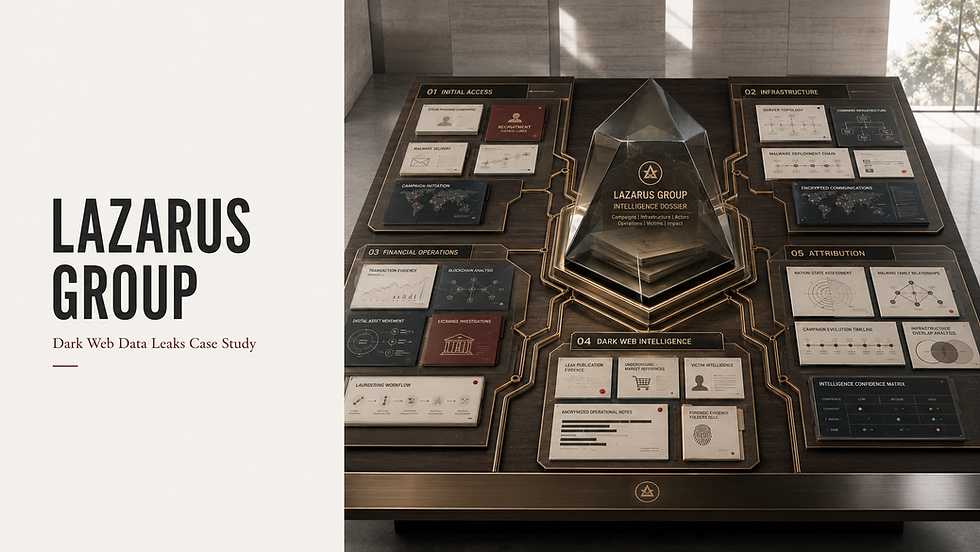
North Korea's State-Sponsored Cyber Operation Behind Global Espionage, Billion-Dollar Crypto Theft, Supply Chain Attacks, and Dark Web Extortion.
Introduction
The global cyber threat landscape is populated by diverse adversaries, ranging from localized hacktivists to financially motivated ransomware syndicates. However, few entities present as complex, multifaceted, and persistent a threat as the state-sponsored collective known as the Lazarus Group. Operating under the direct authorization of the Democratic People’s Republic of Korea (DPRK) and structurally aligned with its military intelligence organ, the Reconnaissance General Bureau (RGB), the Lazarus Group occupies a unique position in modern cyber warfare. Unlike conventional advanced persistent threat (APT) actors that specialize exclusively in espionage, or cybercriminal syndicates that chase financial rewards, the Lazarus Group executes a triple-threat mandate. It simultaneously conducts sophisticated intelligence-gathering espionage, destructive network sabotage, and multi-billion-dollar financial heists. This operational model is not merely a pursuit of malicious activity it is a calculated geopolitical survival mechanism. Facing strict international sanctions and profound economic isolation, the North Korean state leverages the Lazarus Group to acquire foreign currency, fund its nuclear weapons and ballistic missile development programs, and disrupt critical infrastructure globally.
Defenders must study the Lazarus Group with rigorous detail. Their operations demonstrate a remarkable capacity to exploit both the human element through high-touch social engineering and technical vulnerabilities, ranging from outdated legacy software to zero-day flaws in widely used browsers. By analyzing their multi-platform malware ecosystem, specialized subgroups, and evolving technical infrastructure, security organizations can transition from a reactive defense posture to a proactive, threat-informed architecture capable of detecting and containing the most sophisticated threat actors active today.
Who is the Lazarus Group?
The origins of the Lazarus Group are traced back to at least 2009, with their initial activities characterized by large-scale but technically rudimentary distributed denial-of-service (DDoS) campaigns targeting US and South Korean government websites. This early phase, dubbed "Operation Troy," utilized basic malware variants like Mydoom and Dozer to overwrite the master boot record (MBR) of infected systems, introducing a calling card that would evolve into highly destructive disk-wiping payloads in later campaigns. Over the next decade and a half, the group transformed from a localized disruptive actor into an agile, globally targeted, and technically advanced persistent threat. Attribution of this threat actor has been established through exhaustive forensic investigations by international law enforcement agencies, private cybersecurity firms, and state intelligence bodies. The US Department of the Treasury officially sanctioned the group in September 2019, explicitly linking its operations to the North Korean state.
The group’s global footprint is tracked under a complex web of aliases assigned by various national agencies and security vendors. The United States Cybersecurity and Infrastructure Security Agency and the Federal Bureau of Investigation track their core activities as Hidden Cobra, a designation focusing on state-backed botnet infrastructure, distributed denial-of-service operations, and wide-perimeter network compromises. Microsoft maps their targeted campaigns under the terms Zinc and Diamond Sleet, detailing their specialized use of weaponized documentation and open-source software compromises. CrowdStrike monitors their operations as Labyrinth Chollima, highlighting high-investment social engineering campaigns directed at developers and network administrators. Meanwhile, the group's early hacktivist facade was tracked as the Guardians of Peace during destructive corporate actions. Mandiant and Google Cloud maintain a distinct classification for their retail banking and SWIFT-focused operations under the name APT38, while Kaspersky Lab tracks their cryptocurrency-focused division as BlueNoroff. Finally, the division specializing in industrial and defense espionage is widely tracked as Andariel. Rather than a single, monolithic entity, investigations indicate that Lazarus represents a cooperative threat ecosystem structured into discrete, highly specialized cells that share code bases, infrastructure elements, development resources, and laundering pipelines while pursuing distinct strategic objectives.
Lazarus Organization Structure
The division of labor within the Lazarus Group is orchestrated to ensure maximum efficiency across its broad mandate of economic support, technological espionage, and geopolitical retaliation. At the apex sits the Reconnaissance General Bureau (RGB), which dictates high-level strategic targeting. Beneath this authority, specialized subgroups operate with substantial autonomy, each bringing unique technical skill sets and tools to their assigned missions. These specialized units enable the wider Lazarus ecosystem to launch distinct forms of operations simultaneously, complicating the attribution process because separate teams employ different toolchains, communication backends, and victim profiles.
The operational boundaries of these subgroups are structurally demarcated by their core task specializations. The APT38 division, also referred to as the BeagleBoyz, handles the direct manipulation of traditional interbank systems and legacy clearance nodes. These operators exhibit deep technical patience, often dwelling inside compromised banking networks for months to study internal database configurations before initiating fraudulent transactions over the SWIFT network. In contrast, the BlueNoroff cell, also tracked as Sapphire Sleet, is tasked with generating direct cryptocurrency revenue. They specialize in compromising virtual asset service providers, decentralized finance (DeFi) protocols, smart contract bridges, and venture capital companies using high-touch social engineering. The Andariel subgroup, or Onyx Sleet, remains charged with technological, military-industrial, and aerospace espionage. They target defense contractors and nuclear research bodies to extract proprietary engineering schematics, although they also deploy localized ransomware payloads, such as Maui, to extract immediate funds. Finally, the Labyrinth Chollima cell focuses heavily on software supply chain compromises, targeting technical developers and open-source code repositories to infect downstream platforms.
Evolution of Lazarus Operations
The chronological evolution of Lazarus Group operations demonstrates continuous adaptation to changes in global defensive standards, technology architectures, and financial infrastructure. The foundational era spanning 2009 to 2013 was characterized by regional espionage and localized distributed denial-of-service (DDoS) campaigns. These early attacks utilized rudimentary master boot record (MBR) wipers to disrupt South Korean broadcasting and financial organizations, introducing a signature style of destructive network disruption. By 2014, the group graduated to high-impact geopolitical sabotage on the global stage. Their attack on Sony Pictures Entertainment weaponized the "Destover" disk wiper and resulted in the exfiltration of massive volumes of proprietary media and sensitive corporate communications, indicating a growing capability for deep network infiltration. This was followed in 2016 by the historic Bangladesh Bank cyber heist, where the group exploited local SWIFT server credentials to attempt the theft of nearly one billion dollars, redefining the threat vectors targeting central interbank clearance systems.
The latter half of the decade saw the deployment of highly automated and financially lucrative payloads. In 2017, the group launched the WannaCry global ransomware epidemic, using the leaked "EternalBlue" SMB vulnerability to propagate autonomously across critical infrastructure, including global healthcare networks. Recognizing the rapid expansion of virtual currencies, the group shifted focus between 2018 and 2020 toward cryptocurrency exchanges. They developed "AppleJeus," a multi-platform backdoor disguised as a functional trading application, to compromise exchange hot wallets. Between 2021 and 2023, the group focused heavily on software supply chains. This was illustrated by the 3CX "SmoothOperator" campaign, where they compromised an upstream developer platform to sideload backdoors into code-signed updates delivered to millions of unsuspecting endpoints. In the current era spanning 2024 to 2026, Lazarus has integrated generative artificial intelligence to produce highly polished developer personas and LinkedIn job lures while simultaneously utilizing zero-day browser vulnerabilities to infect target environments.
How Lazarus Makes Money
The financially motivated campaigns of the Lazarus Group are designed to bypass international trade embargoes and generate hard currency for the state. Their highest-yielding activity involves direct cryptocurrency exchange theft. Rather than targeting individual retail wallets, Lazarus targets centralized cryptocurrency exchanges, hot wallets, and multi-signature custody engines. By extracting administrative private keys, they authorize massive digital asset transfers directly to attacker-controlled staging addresses. As decentralized finance (DeFi) platforms expanded, Lazarus adapted by targeting smart contracts and cross-chain bridges containing large pools of locked liquidity. By exploiting smart contract vulnerabilities or compromising validator nodes, they execute automated draining routines.
While less common today than cryptocurrency heists, the group maintains the capability to execute traditional interbank SWIFT manipulations. This process involves infiltrating retail banking database backends, injecting fraudulent transaction records, and routing funds to international accounts managed by regional proxy networks. Additionally, targeted ransomware operations serve as a major revenue generator, particularly through the Andariel subgroup. They deploy selective, double-extortion ransomware payloads, such as the Maui or DTrack variants, to encrypt the systems of healthcare and critical infrastructure providers, demanding payment in privacy-focused digital assets to ensure business continuity.
Attack Lifecycle
To achieve long-term access and successful data extraction, the Lazarus Group uses a structured attack lifecycle that maps to standard security frameworks. The cycle begins with target reconnaissance, using open-source intelligence (OSINT) gathered from professional networking sites like LinkedIn and code repositories like GitHub. Operators build profiles of software developers, database administrators, and system engineers. Once a target is selected, weaponization occurs. The group bundles custom remote access trojans (RATs) into legitimate utilities, trojanized PDF viewers, or open-source libraries. Initial access is achieved by delivering these payloads through highly persuasive recruiter lures, compromised software updates, or direct zero-day exploitation of public-facing servers.
Upon executing the initial payload, the malware bypasses endpoint detection and response (EDR) agents by utilizing custom loaders that run shellcode directly in memory. Persistence is established on the host using scheduled tasks, registry run keys, or by modifying legitimate system services. The actors then initiate credential access and privilege escalation, deploying custom Mimikatz variants or using Bring Your Own Vulnerable Driver (BYOVD) exploits to dump LSASS memory and escalate privileges to SYSTEM. Lateral movement is conducted using native administration utilities like Remote Desktop Protocol (RDP) or Windows Management Instrumentation (WMI) to map the domain. Once the target files or digital asset keys are located, exfiltration is carried out over encrypted C2 channels, DNS tunneling, or HTTPS POST requests. Finally, the actors perform cleanup and evasion, wiping event logs, modifying file access timestamps, and dropping disk wipers to hinder forensic response.
Initial Access Techniques
Lazarus Group's initial access strategy uses a mix of targeted social engineering and active software exploitation to bypass standard perimeter security controls. Under campaigns known as "Operation DreamJob" and "Operation DeathNote," operators create highly polished, professional profiles on LinkedIn masquerading as corporate recruiters for major defense, aerospace, or technology firms. They target key system developers and security researchers, sending highly personalized job offers. After establishing trust, the "recruiter" shares a zipped assessment challenge or a PDF-viewing utility that sideloads remote access trojans directly onto the victim's workstation.
To establish credibility with cryptocurrency and Web3 developers, the group sets up entirely fake corporate entities. For example, they created a mock venture platform named "Veltrix Capital," complete with a professional corporate website, vision statements, and active developer repositories on GitHub. Under the guise of a code evaluation task, they deliver trojanized npm packages to targeted developers, allowing them to compromise local developer environments. They also compromise resilient networks by poisoning the software supply chain, publishing highly polished packages to npm or PyPI that mimic popular open-source libraries. Once developers run these packages, the installation scripts launch credential and cryptocurrency stealers. Finally, Lazarus quickly exploits public-facing vulnerabilities, targeting critical CVEs in applications like Apache Log4j or Zoho ManageEngine to drop web shells and execute commands on internal networks.
Malware Ecosystem
The Lazarus Group possesses a highly diverse and rapidly evolving malware ecosystem, producing modular tools customized for Windows, macOS, and Linux to target specific functional phases of an attack. Their Windows implants are built around "Manuscrypt" (also known as NukeSped), their core backdoor used since 2013 to support file manipulation, process termination, system profile collection, and secondary payload delivery. They also deploy "LightlessCan," a highly evasive remote access trojan that mimics native Windows commands to bypass command-line logging and detection. Another significant Windows implant is "SIGNBT" (PostNapTea), an object-oriented HTTP-based RAT that dynamically resolves Windows APIs during runtime using Fowler-Noll-Vo (FNV) hashing. It stores configurations in JSON format, obfuscates communications using dynamic 24-byte XOR keys, and communicates with C2 servers using distinct prefixes, such as SIGNBTLG and SIGNBTKE, to manage logging and configuration retrieval. Other Windows implants include the multi-threaded Fallchill backdoor, the industrial-espionage RAT BlindingCan, the registry-manipulating Volgmer trojan, the wormable WannaCry ransomware, and the healthcare-targeting Maui ransomware.
In addition to Windows-specific implants, Lazarus utilizes specialized cross-platform utilities to infiltrate diverse environments. This includes "AppleJeus," a multi-platform backdoor disguised as a cryptocurrency trading application installer that targets macOS and Windows systems to harvest digital asset credentials. They also deploy "ELECTRICFISH," a proxy tool designed to tunnel high-volume traffic out of protected networks by encapsulating data into outbound TCP connections. For evasion, they leverage the Qt framework to build backdoors such as "MagicRAT" and its smaller, compacted successor "QuiteRAT," which make reverse-engineering difficult by increasing code complexity. The group also deploys host-profiling tools, such as the "TigerRAT" system profiling backdoor, "Gopuram," a selective backdoor used to establish secondary persistence, and "LPEClient," an advanced reconnaissance utility that harvests system metadata to download matching payloads.
To target modern developer workflows, the group has developed node-centric and cross-platform tools. This includes "BeaverTail," a JavaScript-based credential and cryptocurrency wallet stealer delivered via trojanized npm packages or node libraries. BeaverTail is designed to pull "InvisibleFerret," a modular, Python-based second-stage backdoor that manages keylogging, system enumeration, file exfiltration, and uses Telegram APIs as a secondary data channel. For macOS environments, they deploy "RustyAttr," a trojan written in the Tauri framework. RustyAttr bypasses static code scanners by hiding its core payloads inside custom macOS extended file attributes (xattrs), leveraging JavaScript preloads to trigger execution and download secondary implants.
MITRE ATT&CK Mapping
The Lazarus Group uses a diverse set of tactics across the MITRE ATT&CK matrix. The group relies heavily on Spearphishing Link and Spearphishing Attachment (T1566) to secure initial access, delivering malicious files via professional networking platforms. They also exploit Supply Chain Compromise (T1195) to distribute malware by poisoning public repositories with malicious packages or trojanizing legitimate enterprise applications. For execution, operators leverage Command and Scripting Interpreters (T1059), actively executing commands via PowerShell, Windows Command Shell, Python, and JavaScript to run discovery scripts and install payloads.
Defense evasion is supported by Obfuscated Files or Information (T1027), where the group uses complex custom encoding, commercial packers like Themida, and hides payloads inside standard image formats. They also leverage Process Injection (T1055) to hide active backdoor execution inside legitimate native processes like spoolsv.exe. For credential access, they rely on OS Credential Dumping (T1003) to steal password hashes and bypass access restrictions. Lateral movement is conducted using Remote Services (T1021) to connect via Remote Desktop Protocol (RDP). Indicator Removal (T1070) is used to wipe event logs and modify file access timestamps to delay detection. For impact, they deploy Data Encrypted for Impact (T1486) through targeted ransomware. Exfiltration is managed via Exfiltration Over C2 Channel (T1041) and automated clipboard scraping (T1020). They route operational traffic using Multi-hop Proxies (T1090) to obscure the geographic origin of their C2 nodes.
Major Global Campaigns
The history of the Lazarus Group includes some of the most visible, high-impact cyber campaigns ever recorded. In 2014, the group executed the Sony Pictures SPE breach, a politically motivated campaign launched in response to a satirical film depicting North Korean leadership. Under the "Guardians of Peace" banner, Lazarus compromised the corporate network, exfiltrated terabytes of confidential employee data and unreleased films, and deployed the "Destover" wiper to destroy more than half of the company's internal server infrastructure. This was followed in 2016 by the Bangladesh Bank cyber heist, where operators installed custom malware on the bank’s local SWIFT server to acquire administrative credentials and route 35 fraudulent transfer requests totaling nearly one billion dollars to the Federal Reserve Bank of New York. While most transfers were blocked, $81 million was routed to accounts in the Philippines, highlighting vulnerabilities in interbank clearance nodes. In 2017, the group launched the WannaCry global ransomware outbreak, utilizing the stolen "EternalBlue" SMB vulnerability to propagate autonomously across networks, causing immediate disruption to healthcare providers.
In recent years, the group has focused heavily on the cryptocurrency and Web3 sectors, executing several high-yield exploits targeting smart bridges and decentralized finance platforms. This includes the 2021 Poly Network hack, which drained $600 million, and the 2022 Ronin Bridge hack, where spearphishing compromised validator nodes to steal $625 million from the Axie Infinity network bridge. They also targeted the Nomad Bridge in 2022, draining $190 million by exploiting smart contract parameters. In 2023, the group compromised Atomic Wallet, stealing $100 million in virtual assets, and drained $41 million from the online gaming platform Stake.com by stealing private keys. This trend continued with the 2024 WazirX exchange breach in India, where the group compromised a multi-signature wallet system to steal $235 million in virtual assets.
The largest financial hack attributed to the group occurred in late February 2025 with the Bybit cryptocurrency exchange heist, resulting in the theft of approximately $1.5 billion in Ethereum. Lazarus developed a counterfeit wallet management interface that mirrored Bybit's internal asset dashboard. Using targeted social engineering, the actors deceived Bybit executives into signing transaction requests, authorizing the transfer of over 400,000 ETH from the exchange's cold storage to an attacker-controlled hot wallet. To manage the liquidity crisis and maintain customer confidence, Bybit secured emergency investor funding, and proof-of-reserves audits confirmed a 100%+ reserve ratio across remaining wallets, while global tracking networks identified that the hackers successfully laundered over $300 million of the stolen assets.
Industries and Countries Most Targeted
The Lazarus Group’s operations target a broad range of sectors and geographies, aligning with the North Korean regime's requirements for military intelligence, technological development, and financial survival. They target defense contractors and aerospace engineers to gather proprietary research, aviation schematics, and manufacturing designs to support state military development. The healthcare and public health sector is subjected to ransomware campaigns, such as Maui, to extract immediate cryptocurrency payments while gathering research data. Traditional retail banking infrastructure is targeted to execute SWIFT clearance bypass campaigns, while cryptocurrency platforms, Web3 developers, and decentralized exchanges are targeted for digital assets to bypass global trade barriers. They also target upstream software developers to inject backdoors into legitimate enterprise software updates.
While Lazarus Group campaigns are global, their targeting patterns align with specific strategic and political relationships. Geopolitical rivals like South Korea are heavily targeted for military and political intelligence, regional leverage, and network sabotage. The United States remains a primary target for technological espionage against defense contractors and heists targeting major Web3 platforms. India has emerged as a major target of cryptocurrency exchange heists, such as the WazirX compromise, and engineering espionage. Japan is targeted for both corporate espionage and cryptocurrency theft, including the $305 million DMM Bitcoin breach. Additionally, Singapore and the UAE are targeted due to their high concentration of digital asset firms and decentralized exchange platforms, while Australia and Europe are targeted to harvest aerospace, maritime, and defense secrets.
Cryptocurrency Operations and Laundering Workflows
Lazarus uses multi-layered laundering methods to obfuscate blockchain transactions and convert stolen assets into fiat currency. The process begins with chain hopping, where the group uses automated swaps to move stolen digital assets across different blockchain networks. For example, they convert stolen ERC-20 tokens into Bitcoin via cross-chain bridges, breaking the continuous transaction history on any single ledger. Once swapped, the stolen crypto is routed through privacy-focused mixing protocols, such as Tornado Cash, Sinbad, YoMix, or Wasabi Wallet. These services pool large volumes of cryptocurrency and distribute them to destination addresses in randomized increments, obscuring the connection back to the initial theft.
Once mixed, the funds are routed to unaligned Over-the-Counter (OTC) crypto brokers or underground shell networks. These brokers accept the mixed crypto assets and convert them into standard fiat currency, such as USD or CNY, which is then deposited into state-backed bank accounts. This multi-stage process of chain hopping, mixing, and OTC off-ramping allows the group to bypass international sanctions, hide transaction trails, and integrate stolen digital assets into the global financial system.
Technical Infrastructure
Lazarus maintains a globally distributed infrastructure to support its C2 networks and hide its operational origin. To mask the origin of their traffic, operators route C2 data and interactive execution sessions through trusted residential proxy networks and anonymous Virtual Private Servers. This ensures that malicious administrative connections appear to originate from normal home or small-office internet connections inside the victim's local region, bypassing geofencing alerts and behavioral perimeter controls. They also register large blocks of domain names that mimic legitimate IT services, configuring these domains with Fast-Flux DNS to rapidly cycle IP addresses and prevent automated blocklists.
The group also abuses public cloud platforms for data staging and configuration hosting. For instance, during the 3CX campaign, the trojanized installer pulled benign-looking ICO files from legitimate GitHub repositories to decrypt C2 configurations. In mid-2025, security researchers identified an infrastructure overlap between Lazarus and the Russia-nexus Gamaredon group. During analysis of Lazarus’ Contagious Interview payloads, researchers found a shared IP address configuration hosting an obfuscated version of the InvisibleFerret backdoor on a server previously associated with Gamaredon activity. While it remains unclear if Lazarus leveraged a Gamaredon-controlled server or if both actors shared the same client instance, this infrastructure overlap suggests emerging dynamics of shared cyber resources across national boundaries.
Tactics, Techniques, and Procedures Reference
To successfully compromise target networks, the Lazarus Group implements a highly coordinated set of tactics, techniques, and procedures across each stage of intrusion. During initial access, they rely on spearphishing campaigns, posing as recruiters on professional networking sites to deliver trojanized archives or job challenges directly to software developers. Execution of the initial foothold is often automated using Python-based in-memory scrapers, such as the MLIP or BOW modules, which harvest credentials and clipboard contents without generating standard file-write events on disk. To maintain persistent access across system reboots, the group modifies system registries, adding Run keys or dropping malicious shortcut LNK files into startup directories.
For defense evasion, Lazarus utilizes code smuggling techniques, such as storing executable shellcode within custom macOS extended file attributes to bypass static scanners. Once a persistent foothold is established, operators perform credential access, running customized Mimikatz variants to dump LSASS memory and harvest domain passwords. System discovery is conducted using tools like LPEClient, which gathers host metadata and registry configurations to verify target details before downloading secondary implants. Operators then move laterally across subnets, utilizing interactive Remote Desktop Protocol connections with compromised system accounts. Command-and-control communications are managed using standard web protocols, with backdoors like SIGNBT disguised as benign HTTP traffic to blend in with normal network activity. Finally, the group deploys encryption tools, such as the Maui ransomware, to lock critical server and database configurations, disrupting business operations to force financial payouts.
Indicators of Compromise for Security Operations Centers

Security Operations Centers (SOC) should configure SIEM detection rules and threat hunting queries to monitor for behavioral indicators of Lazarus Group activity. Analysts should flag unusual interactive processes, such as when python.exe or node.exe is spawned by communication applications, video call platforms, or browser download directories, such as Slack, Zoom, or Chrome. This is a key indicator of fake interview payloads launching from developer workstations. Additionally, monitor for DLL side-loading behaviors, where legitimate, signed system executables load unsigned, untrusted DLL files from user-writable directories like %APPDATA% or %TEMP%. For example, track signed binaries loading custom vnclang.dll or ffmpeg.dll files.
On macOS systems, SOC teams should audit command-line executions of xattr -w or custom calls to macOS metadata layers, as this behavior is associated with the RustyAttr trojan smuggling malicious code within non-standard extended file attributes. For network monitoring, identify internal endpoints making sudden, high-volume connections to dynamic DNS providers, Tor routing nodes, or residential proxy spaces. Finally, configure host-based rules to flag changes to administrative services. For example, monitor when core system services like ssh-agent or SQL databases are stopped and their underlying binaries are modified, which is a common persistence strategy used by ServiceChanger to sideload malicious libraries.
Beyond behavioral and heuristic logic, network defenders must configure proactive firewall and endpoint detections for specific technical indicators identified in recent Lazarus Group intrusion chains. Security Operations Centers must implement SIEM alerts for outbound connection attempts targeting known Lazarus command-and-control (C2) servers located at the IP addresses 23.254.119.11 and 104.194.160.65. Network monitoring platforms should also flag traffic patterns routing through broader subnets associated with this infrastructure, notably the Classless Inter-Domain Routing (CIDR) ranges of 23.254.119.0/24 and 104.194.160.0/24. Domain Name System (DNS) querying logs must be continually swept for resolution requests involving the spoofed staging domains globalcoinclearing[.]com, northernservice[.]com, and cdfinance[.]net, which the threat actors host to intercept financial and Web3 utility communications. At the host level, Endpoint Detection and Response (EDR) platforms should be configured to flag the initialization of malicious Mutex patterns used by the malware loader engine to enforce singular execution instance controls, specifically auditing for the presence of the mutex markers kjdw8392dkedue and MyMutexName123. Finally, security analysts must incorporate automated filesystem and memory scans to detect file footprints matching known malicious SHA256 hashes, specifically targeting c6d01f5dbf85c3dd62f4d56c7f0e2f5a6b8c9d0e1f2a3b4c5d6e7f8a9b0c1d2e and d7e12g6echf96d4ee73g5e67g8f0f3g6b7c9d0e1f2a3b4c5d6e7f8a9b0c1d2e3f to preemptive contain active backdoor deployments inside developer and financial network boundaries.
Detection and Defensive Strategies
To defend against the Lazarus Group’s campaigns, organizations must implement a multi-layered security framework that goes beyond traditional signature-based defenses. Endpoint Protection and EDR agents should be configured to analyze runtime behaviors, process hollowing, memory-only injections, and untrusted DLL load attempts, as static scanners are easily bypassed by packed payloads. Organizations must also deploy robust identity security, enforcing FIDO2-compliant physical multi-factor authentication. Standard SMS or push notifications are vulnerable to social engineering, but hardware-based security keys block unauthorized logins even if credentials or session tokens are stolen.
Furthermore, software development companies must implement automated software composition analysis (SCA) inside their developer pipelines. This process involves continuously scanning all code repositories for poisoned npm, PyPI, or GitHub dependencies before build processes are executed to prevent supply chain contamination. Finally, enforce strict zero-trust least-privilege principles across the entire enterprise. Developers, system engineers, and database administrators must operate with the minimum level of permissions required to perform their tasks, and access to smart contract environments, source code repositories, and Domain Controllers should be heavily restricted and isolated.
Lessons Learned
The activities of the Lazarus Group offer several critical lessons for the global cybersecurity community. Firstly, nation-state cyber operations are increasingly used as direct fiscal mechanisms to bypass global sanctions and generate hard currency, demonstrating that geopolitical adversaries can operate with purely financial motives to fund state programs. Secondly, the human element remains a primary point of vulnerability threat actors are willing to invest months building professional relationships on social networks to establish trust before executing an intrusion.
Additionally, supply chain risk management is essential. Infiltrating a single upstream vendor or open-source package allows threat actors to bypass traditional perimeter defenses across thousands of downstream organizations simultaneously. Finally, defensive teams must recognize that threat actors continually evolve their tooling. The group's rapid adoption of new programming environments, such as the Qt and PureBasic frameworks, demonstrates their commitment to developing complex code bases that bypass traditional static scanners, requiring defenders to focus on behavioral runtime analysis.
Future Outlook
The future strategy of the Lazarus Group is expected to incorporate even more advanced deception and automation techniques. The group will continue to integrate generative AI tools into their social engineering campaigns, allowing them to create highly realistic, personalized recruiter profiles and professional personas on social networking platforms to target technical staff. They are also expected to expand their focus on the software supply chain, targeting open-source package repositories and developer environments to inject silent backdoors into upstream software libraries.
In the virtual asset space, Lazarus will likely refine its targeting of Web3 and decentralized finance (DeFi) platforms. They will focus on exploiting smart contract parameters, validator nodes, and cross-chain bridge contracts to execute rapid drain campaigns. Finally, threat actors will continue to develop modular, cross-platform malware targeting macOS and Linux server nodes. This represents a shift away from Windows-only payloads, enabling them to establish persistent access within cloud infrastructure and diverse developer environments.
Key Takeaways
The Lazarus Group represents an agile, state-sponsored cyber operation that combines espionage, financial heists, and destructive sabotage into a unified campaign. Driven by the geopolitical requirements of the North Korean state, their tactics are highly sophisticated, exploiting both human vulnerabilities and zero-day software vulnerabilities to infiltrate resilient targets. As the group continues to evolve its malware ecosystem, defensive operations must focus on behavioral detection, rigorous software supply-chain auditing, and robust identity protection to effectively counter this persistent threat.


Comments