
Payload Ransomware Group: Dark Web Data Leaks Case Study
- securedmonk
- Jun 15
- 11 min read

The contemporary architecture of Dark Web Cybercrime has evolved from basic, local file-locking campaigns into highly orchestrated corporate extortion operations. In this current threat environment, the primary leverage has shifted from encrypting servers to executing systematic, public data exposure campaigns. The proliferation of dedicated onion-routed extortion nodes has allowed threat groups to weaponize proprietary corporate assets, forcing organizations to confront severe regulatory, financial, and reputational liabilities. Security operations centers can no longer protect assets simply by relying on offline data recovery; instead, they must implement a defense-in-depth model that anticipates both host-level encryption and stealthy network data exfiltration.
By utilizing advanced Data Leak Analysis and Cyber Threat Intelligence frameworks, defensive coordinators can dissect the inner workings of emerging threat actors to build more resilient defenses. The emergence of the Payload Ransomware Group in early 2026 represents a highly active, structurally disciplined example of this modern double-extortion operational model. This case study provides an exhaustive Payload Ransomware Analysis, tracing the group's origins, dark web publishing mechanics, backend host infrastructure, and specific technical binary capabilities.
Modern ransomware attacks no longer depend solely on encryption. Data theft and public exposure have become equally powerful extortion tools, transforming a localized IT recovery incident into a catastrophic public breach.
Who are Payload Ransomware Group?
First identified by threat intelligence teams in mid-February 2026, the Payload Ransomware syndicate established itself as a globally oriented threat actor. The group's debut campaign occurred on February 13, 2026, targeting SODIC, one of Egypt’s premier real estate development companies, which marked the initial launch of the Payload Dark Web Leak Site. Rather than operating as an open Ransomware-as-a-Service (RaaS) platform with hundreds of disparate affiliates, the group appears to work as a tightly coordinated, closed cybercriminal cell. This structure yields a highly disciplined operational timeline, with targeting focuses placed on organizations managing high-value supply chains, proprietary databases, and sensitive personal information.
Over the course of its first few months of active development, the group rapidly populated its Payload Victim List, disclosing targets spanning multiple continents, including North America, Europe, the Middle East, and Southeast Asia. As of March 24, 2026, the group had listed 50 victims, showcasing an aggressive operational tempo that averages more than a dozen new compromises per month.
The following Payload Threat Actor Analysis outlines the primary profiles and tactical baseline established by this syndicate :
Metric / Core Profile | Details |
First Known Activity | February 15, 2026 (First public victim listed on February 13, 2026) |
Extortion Model | Double Extortion Ransomware (Symmetric encryption and public leak site data exposure) |
Primary Tor Link | payloadrz5yw227brtbvdqpnlhq3rdcdekdnn3rgucbcdeawq2v6vuyd.onion |
Operational Status | Active |
Geographic Target Footprint | Global (Egypt, Mexico, Poland, Thailand, Germany, Malaysia, Singapore, USA, Ireland) |
Locker Variants | PE32 Windows executables ; 64-bit Linux ELF binaries for VMware ESXi hypervisors |
Payload Dark Web Leak Site Analysis

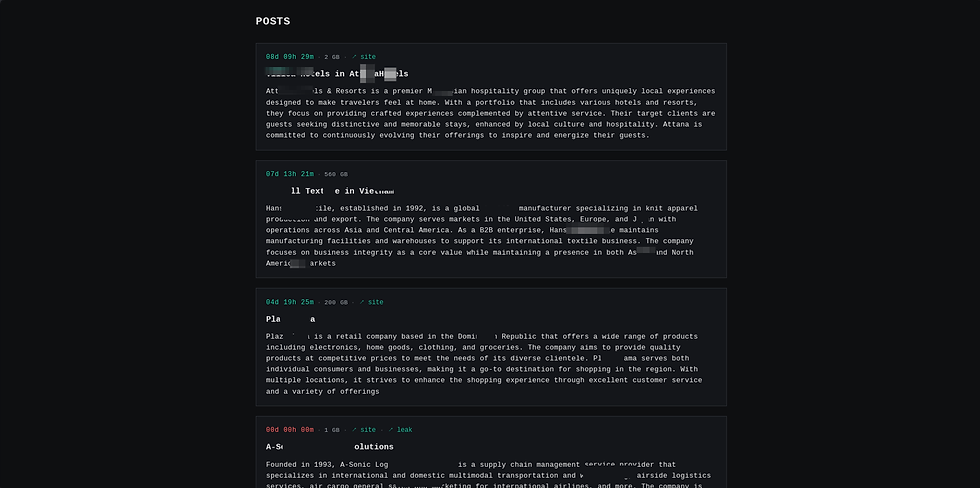
The primary communication and pressure mechanism for the group's extortion campaigns is the Payload Onion Site. Designed to resemble a professional corporate index, the portal minimizes visual clutter to present a clean, business-like index of breached organizations, as captured on the main listings page (Image 3). This deliberate aesthetic strips away any amateurish connotations, framing the extortion as a cold, transactional dispute over proprietary data assets.
On this listings interface, victims are displayed as structured cards that contain the organization's name, a descriptive summary of their business model, and critical extortion metadata (Image 3). The platform prominently highlights:
The Publication Timer: Active countdown clocks indicating the exact days, hours, and minutes remaining before the data is publicly released.
Stolen Data Volumes: Precise metrics (e.g., 2 GB, 200 GB, or 560 GB) that validate the size of the exfiltrated archives.
Leak Status Indicator: Labels indicating whether a target is "pending" negotiation or if the data has been fully published ("leak").
Download Access Links: Dedicated links pointing directly to the underlying data stores.
By continuously displaying this active victim index, the group uses its Payload Data Leak Portal to build operational credibility, demonstrating to future targets that they systematically execute their threats if negotiations fail.
How Payload Pressures Victims
The operational mechanics of this syndicate rely heavily on a highly calculated Double Extortion Ransomware sequence. By executing host encryption and quiet network exfiltration in parallel, the Payload Extortion Group creates a critical point of leverage that cannot be mitigated by standard offline backups.
This progressive timeline ensures that the dark web listing itself functions as a secondary attack phase. The moment an organization is published on the portal, third-party supply chain partners, compliance auditors, and regulatory bodies are alerted to the breach, inducing immediate reputational damage and legal liability before any data has actually been released.
Victim Disclosure Process
To maximize psychological pressure, the group deploys dedicated, highly customized victim profile pages on its portal, as illustrated on the A-Sonic Logistic Solutions Victim Page (Image 2). Rather than merely posting raw lists of names, the threat actors compile comprehensive briefings detailing the target’s corporate history, annual revenue estimates, geographic footprints, and its functional role within regional supply chains.
By detailing this organizational context, the operators systematically alert the victim's downstream customers and business partners to the compromise. For instance, when a critical logistics provider like A-Sonic is listed, the immediate implication is that transit manifests, shipping logs, commercial contracts, and customs documentation are exposed. This disclosure triggers downstream vendor panics, forcing the victim organization to manage external client fallout and regulatory reporting requirements while simultaneously attempting to resolve the primary system outage.
Data Leak Infrastructure
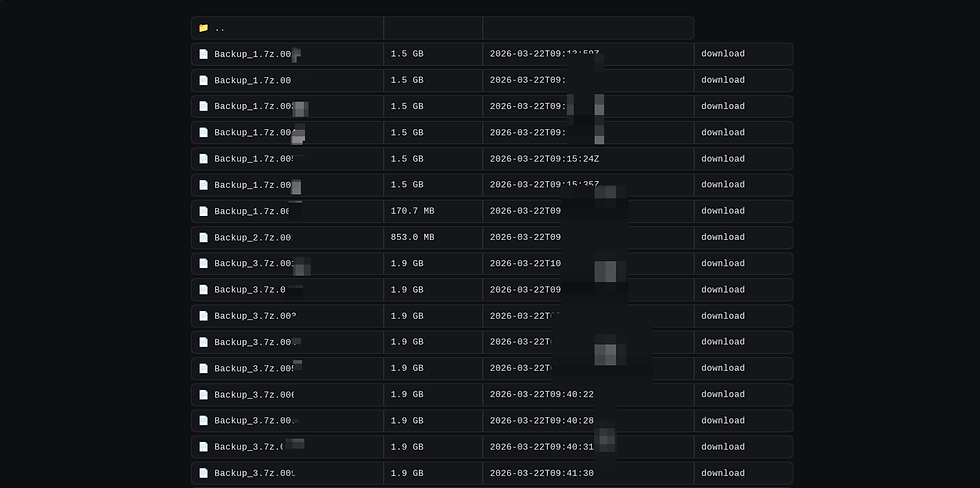
Behind the simple interface of the onion portal lies a robust backend Payload Leak Infrastructure engineered to facilitate the transfer of multi-gigabyte data dumps over high-latency networks. As documented in the backup archive interface (Image 4), the group avoids publishing unstructured file lists, opting instead to package exfiltrated databases into segmented, highly compressed archives using formats like .7z.
This systematic archive segmentation splits large data volumes into highly manageable chunks—consistently sized between 1.5 GB and 1.9 GB (Image 4). This structure allows external downloaders and researchers to pull individual segments of the leak without needing to sustain continuous, high-bandwidth connections to the onion node, ensuring the data is successfully distributed despite Tor network constraints. The published directories typically expose highly structured corporate structures:
Exposed Data Category | Common Internal File Contents |
Corporate Financials | Bank statements, general ledgers, tax returns, wire transfers, and internal audits. |
Personnel Records | Passport scans, medical insurance enrollments, employee payrolls, and employment contracts. |
Operational Data | Network topology maps, Active Directory schema dumps, SQL databases, and internal emails. |
Legal & Regulatory | Non-disclosure agreements (NDAs), patent applications, client contracts, and vendor compliance files. |
Types of Data Exposed

Before publishing a full multi-gigabyte data dump, the group frequently releases a partial file directory listing to prove the authenticity of their compromise. This pre-exposure phase is captured on the directory tree screenshot (Image 1), which reveals direct network paths on a compromised file server (\\192.168.13.201\Datos\PERSONALES). The path list displays a detailed directory structure belonging to internal users such as d.valero and b.rodriguez, exposing scientific research documents, projects, and local browser profiles (Image 1).
These directory path lists serve as undeniable forensic evidence of a deep, administrative compromise on the victim's network. By showcasing internal file names, localized directory paths (such as AVI\Memoria Talent L3 Innodocto 2020-v2.doc), and user-specific folders, the threat actors eliminate any deniability, forcing the victim's incident response team to acknowledge that sensitive personal and corporate data has been exfiltrated.
Technical Analysis of Payload
Through comprehensive Ransomware Threat Research, malware analysts have reconstructed the core technical attributes of the locker. The primary payload is compiled as a highly optimized, multi-threaded PE32 Windows executable utilizing the Microsoft Visual C++ Concurrency Runtime (ConcRT) to achieve maximum encryption speeds. Additionally, threat researchers have analyzed a companion 64-bit Linux ELF variant designed to target VMware ESXi virtualization hosts, which appends the .xx0001 or .payload extension and uses similar high-speed encryption loops.
Execution Phase & System Profiling
Upon launch, the ransomware registers a global mutex named MakeAmericaGreatAgain to ensure only a single instance of the locker executes on the target endpoint. It immediately checks for debugging hooks by verifying if a debugger is attached (in the ESXi variant, it reads /proc/self/status for a non-zero TracerPid field), terminating itself if it detects an analysis or sandbox environment.
To optimize its encryption runtime, the locker queries the host processor's SIMD capabilities via CPUID and XGETBV instruction sets. It checks for SSE2 support (EDX bit 26), AVX support (ECX bits 28/27), and queries extended feature flags to detect AVX2 support (EBX bit 5). Based on the resulting capability mask, it dynamically registers a function pointer to the fastest available cryptographic routine, leveraging 256-bit wide AVX2 registers if supported by the host hardware.
Cryptographic Workflow
The malware leverages a highly secure, modern hybrid cryptographic model. It utilizes symmetric ChaCha20 for bulk file locking and asymmetric Curve25519 ECDH key exchange to securely transfer the encryption keys. The cryptographic process is designed to prevent local key recovery:
Shared Secret=X25519(Victim Ephemeral Private Key,Attacker Public Key)
The raw 32-byte X25519 output is used directly as the ChaCha20 encryption key. The victim's ephemeral private key is generated fresh per file using CryptGenRandom and is zeroed in memory (VA 0x4098CC–0x4098DB) immediately after key derivation, rendering nonce reuse and local key recovery structurally impossible. Files are encrypted in 1 MB chunks to manage memory footprint and maximize I/O throughput. At the end of every locked file, the malware appends a 56-byte RC4-encrypted footer containing the victim's ephemeral public key and the nonce, encrypted with the hardcoded 3-byte key "FBI".
Defense Evasion & Service Termination
The ransomware incorporates aggressive anti-forensic measures to disable endpoint security monitoring and prevent administrative recovery :
ETW Memory Patching: By checking the --bypass-etw command-line flag, the malware can dynamically patch the EtwEventWrite API in memory, preventing the Windows operating system from logging event telemetry.
Direct NT System Calls: To bypass standard user-mode API hooking deployed by modern EDR agents, the malware uses direct system calls and resolves Native NT APIs (such as NtOpenFile and NtQueryInformationFile) dynamically.
Recovery Disruption: It kills Windows Volume Shadow Copies using native shell execution commands to remove local system restore points.
Self-Deletion Mechanism: On completion, it executes an NTFS Alternate Data Streams (ADS) self-deletion routine to wipe the primary locker binary from the disk, leaving minimal post-compromise artifacts.
The malware aggressively terminates active processes and services associated with database managers, security agents, remote management tools, and backup suites to release active file locks :
Target Process Kill List :
Databases: sql.exe, oracle.exe, ocssd.exe, dbsnmp.exe, dbeng50.exe, agntsvc.exe, isqlplussvc.exe
Backup & Admin: sqbcoreservice.exe, synctime.exe, ocautoupds.exe
Remote Access & Email: mydesktopservice.exe, mydesktopqos.exe, encsvc.exe, tbirdconfig.exe, outlook.exe, thunderbird.exe
Office & Productivity: excel.exe, winword.exe, powerpnt.exe, msaccess.exe, onenote.exe, notepad.exe
Target Service Kill List :
Backup Engines: veeam, VeeamTransportSvc, VeeamDeploymentService, VeeamNFSSvc, mepocs, YooBackup, BackupExecVSSProvider, BackupExecAgentAccelerator, BackupExecRPCService
Volume Shadow Copy: vss, GxVss, VSNAPVSS
Security Software: sophos, DefWatch, ccEvtMgr, ccSetMgr, RTVscan, zhudongfangyu (360 Total Security)
Database & Financial: sql, QBFCService, QBIDPService
Case Study – Gorey Community School
On May 13, 2026, the Payload Ransomware Group claimed responsibility for a targeted cyberattack against Gorey Community School, a prominent co-educational academic institution located in Wexford, Ireland. The attack successfully compromised the school's administrative network, resulting in the exfiltration of 125GB of sensitive internal files, including student lists, staff personnel files, financial statements, and local child protection documentation. The group listed the school on its Tor onion site and issued a direct statement threatening a full public data release unless immediate negotiations were opened.
This incident highlights the growing threat model confronting the global educational sector. Extortion groups target schools and universities due to several factors:
High-Density PII: Academic networks manage thousands of personal data records containing medical, financial, and family records.
Underfunded Security Controls: Public educational institutions often operate on highly restricted IT budgets, resulting in flat network architectures, unpatched legacy gateways, and minimal endpoint security tooling.
Operational Disruption: The immediate administrative chaos caused by ransomware locking academic registration platforms provides attackers with significant leverage to demand rapid settlements
Industries Targeted by Payload
CTI analysis shows that the Payload Ransomware Group operates with opportunistic targeting habits, selecting victims where operational downtime causes maximum business disruption. Rather than focusing on a single industry vertical, the group targets sectors with highly distributed supply chains or continuous, high-volume transactions.
The table below catalogs several notable victim disclosures, highlighting the group's global footprint and industry breadth :
Victim Organization | Region | Industry Vertical | Stolen Data Volume | Leak Status |
Hansoll Textile | South Korea / Vietnam | Knit Apparel Manufacturing | 560 GB | Fully Disclosed ("leak") |
Plaza Lama | Dominican Republic | Supermarket & Retail Department | 200 GB | Fully Disclosed ("leak") |
Gorey Community School | Ireland | Secondary Education | 125 GB | Under Negotiation / Pending |
Villea Hotels | Malaysia | Hospitality & Tourism | 2 GB | Pending Release |
A-Sonic Logistic Solutions | Singapore | Supply Chain Logistics | 1 GB | Fully Disclosed ("leak") |
Indicators and Detection Opportunities
Indicator Type | Value / Pattern | Context / Description |
SHA-256 Hash | 1CA67AF90400EE6CBBD42175293274A0F5DC05315096CB2E214E4BFE12FFB71F | Windows PE32 Ransomware Binary
|
SHA-256 Hash | BED8D1752A12E5681412EFBB8283910857F7C5C431C2D73F9BBC5B379047A316 | Linux/ESXi ELF Ransomware Binary
|
MD5 Hash | E0FD8FF6D39E4C11BDAF860C35FD8DC0 | Windows PE32 Ransomware Binary
|
SHA-1 Hash | DDE1B933AAD33C5D96C2E45AD46434A200DC46A6 | Windows PE32 Ransomware Binary
|
Onion Domain (TOR) | payloadrz5yw227brtbvdqpnlhq3rdcdekdnn3rgucbcdeawq2v6vuyd.onion | Primary Tor Extortion and Leak Portal
|
Onion Domain (TOR) | payloadynyvabjacbun4uwhmxc7yvdzorycslzmnleguxjn7glahsvqd.onion | Secondary Tor Extortion and Leak Portal
|
IPv4 Address | Compromised internal file server host IP observed in exfiltrated path listings | |
Mutex | MakeAmericaGreatAgain | Global Windows mutex created by locker to prevent multiple concurrent instances |
Ransom Note | RECOVER_payload.txt | Ransom note dropped on encrypted Windows host systems |
Ransom Note | RECOVERY-xx0001.txt | Ransom note dropped on Linux/ESXi target host datastores |
Ransom Note | welcome.txt | Ransom message replacing default ESXi host UI welcome greeting |
File Extension | .payload | Extension appended to encrypted files on Windows platforms |
File Extension | .xx0001 | Extension appended to encrypted files on VMware ESXi datastores |
Local Log File | ??\C:\payload.log | Log file path written by the ransomware during active runtime execution |
Config File | recovery.ini | Local configuration file written to store execution keys and state |
Directory Path | \192.168.13.201\Datos\PERSONALES\d.valero\ | Compromised directory path targeted during exfiltration |
Directory Path | \192.168.13.201\Datos\PERSONALES\b.rodriguez\ | Compromised directory path targeted during exfiltration |
Archive Pattern | Backup_1.7z.001 - Backup_1.7z.007 | Exfiltrated segmented archive filenames published to leak infrastructure |
Archive Pattern | Backup_2.7z.001 | Exfiltrated segmented archive filename published to leak infrastructure |
Archive Pattern | Backup_3.7z.001 - Backup_3.7z.009 | Exfiltrated segmented archive filenames published to leak infrastructure |
Early detection is critical to intercepting the ransomware attack chain before the threat actor can stage and exfiltrate sensitive files. SOC teams should establish behavioral detection rules across identity, network, and endpoint vectors to catch the intrusion during its early phases :
Identity Anomalies
Monitor for suspicious administrative logins outside of normal business hours, sudden privilege escalation requests, and the rapid creation of unrecognized local admin accounts. Defensive teams should trigger immediate alerts upon detecting credential-dumping activity from the Local Security Authority Subsystem Service (LSASS) memory space.
Network Egress Anomalies
Exfiltration attempts typically generate highly anomalous data egress patterns. Security teams should monitor for large-scale, outbound file transfers to public cloud storage systems, unapproved FTP endpoints, or known Tor network gateways. Regular beaconing activity to external IP addresses must be investigated for potential command-and-control (C2) callback behavior.
Endpoint & Host Telemetry
Configure SIEM platforms to detect specific command-line arguments and process creations associated with system recovery disruption :
Shadow Copy Erasure: Detect execution of vssadmin.exe delete shadows /all /quiet or wmic shadowcopy delete.
Event Log Cleansing: Flag the usage of wevtutil.exe cl targeting security, system, or application logs.
Memory Patching: Monitor for processes attempting to access or write to Windows API structures like EtwEventWrite to bypass event logging.
Rogue File Activity: Set alerts for high-frequency file renaming operations where standard directory structures are appended with the .payload or .xx0001 extensions.
Defensive Recommendations
To defend against highly active threat actors like the Payload Ransomware Group, organizations must implement a multi-layered security framework designed around Zero-Trust principles.
Identity Security & Access Control
Enforce robust, hardware-backed Multi-Factor Authentication (MFA) across all remote access gateways, corporate VPNs, and internal administrative panels. Implement Privileged Access Management (PAM) tools to enforce the principle of least privilege, ensuring that domain admin credentials are never cached on standard endpoint workstations.
Endpoint Protection & Application Control
Deploy modern Endpoint Detection and Response (EDR) platforms across all physical and virtual hosts, including ESXi hypervisor endpoints. Enable strict application control policies to block the execution of untrusted binaries, unrecognized scripts, or unauthorized remote monitoring and management (RMM) tools.
Network Segmentation
Implement logical network segmentation to isolate critical development directories, operational databases, and hypervisor management networks from standard corporate workstation segments. This structural barrier prevents threat actors from easily conducting lateral movement or locating sensitive data stores during the reconnaissance phase.
Immutable Backup Architectures
Ensure that all system backups are stored in offsite, air-gapped repositories that are entirely isolated from the primary corporate network. Organizations must utilize immutable storage platforms where data records cannot be encrypted, deleted, or modified, even if administrative credentials are stolen. Regularly test the recovery process to guarantee rapid business restoration.
Conclusion
The emergence of the Payload Ransomware Group represents the ongoing refinement of the modern double-extortion operational model. By combining fast, hardware-optimized cryptographic lockers with aggressive anti-forensics, direct NT system calls, and a highly publicized Ransomware Leak Site pressure model, this group successfully targets high-value corporate targets globally. Surviving these campaigns requires enterprise security teams to move away from legacy perimeter defenses, adopting proactive threat monitoring, network segmentation, and immutable offsite backups to disrupt threat actions before data exfiltration occurs.



Comments